
The Moment the Old Answers Stop Working
There is a moment that comes for many of us in adulthood when the things that used to make sense stop making sense. It happens slowly, and you may not even notice when it started. But at some point you realize that the ways you have been understanding your life are no longer working. The stories you told yourself about who you were and where you were going stop holding together. The certainties you used to lean on keep cracking open, and what you find underneath is not what any of your stories prepared you for. This is what I call the beginning of rupture, and it is where the next thirteen weeks of this series will live.
I want to do something a little different this week. The first half of the year was mostly essay style, with me building arguments and unpacking ideas in a relatively straightforward way. The territory of rupture moves in fragmented, sometimes contradictory ways, and I think the writing about it should match. Rupture shows up as small recognitions stacked next to each other without a clear story connecting them. So in the middle of this week’s piece, I am going to step out of essay mode and into something closer to journal mode, the way the experience itself actually shows up from the inside.
The author who modeled this kind of writing for me more than any other was Hugh Prather. I discovered his book Notes to Myself in the middle of my own beginning of rupture, when nothing I was reading from the more polished spiritual or psychological writers was landing the way they had previously. Prather was different. His book read more like a journal than a traditional book, with short observations sitting next to longer ones, some entries a single sentence and others running for a paragraph, and none of them connecting in any obvious way to the ones around them. And yet his entries made me feel less alone than anything else I was reading at the time.
Prather said the writing in Notes to Myself was an expression of insights on his current problems, that as he was writing he was in a state of learning, becoming, arriving, and not in a state of knowing and having arrived. That sentence gave me permission for something I did not know I needed permission for. The permission to write from inside a rupture rather than waiting until I had crossed over to the other side and could write about it from a safe distance. Prather modeled how to think and write from inside the experience of becoming, when the becoming was still raw and unresolved.
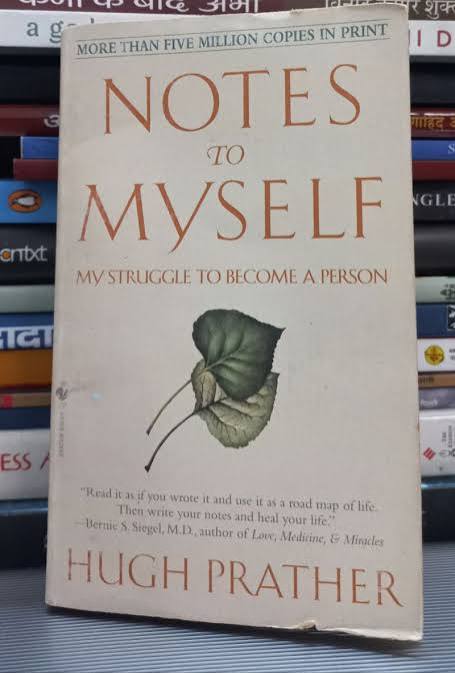


What follows are a series of journal-style entries from my own rupture years, when I was somewhere in the middle of what has taken the rest of my adult life to fully understand. Some of these are direct entries from journals I kept then. Some are reconstructions of the kinds of things I was noticing without yet having language for. All of them try to capture what rupture’s interior voice actually sounded like before any of the frameworks I now have were available to me. These are meant to be read slowly and sat with for a bit. Maybe even come back and contemplate one or two of them that stood out to you in your own journal.
- I keep telling people I am fine, but I am not fine. I don’t know what to say instead.
- My old self would have known what to do here, but I have no idea which way to turn now.
- I notice I want to leave every situation I find myself in. I can’t tell if this is a problem with the situations or a problem with me.
- I am angry at people who seem certain about everything. I used to be one of them and I don’t know what changed.
- Something has been waking up in me for months and I’ve been trying to put it back to sleep. Which is exhausting. I’m starting to wonder what would happen if I stopped trying.
- My body knows something my mind hasn’t caught up to yet. I’m starting to listen to my body even though everything in my upbringing told me my body couldn’t be trusted.
- I read a paragraph in Notes to Myself tonight that landed harder than the last three years of sermons. I don’t know what that means yet so I’m letting it sit there.
- The faith I had at twenty-five doesn’t fit me anymore. The faith I am supposed to have now doesn’t fit me either. I don’t know what to call what is happening, but it’s not unbelief.
- I keep waiting for someone to notice that I’m falling apart. Nobody has noticed. I don’t know whether to be relieved or terrified.
- I am beginning to understand that some of my closest relationships were built on a version of me that doesn’t exist anymore. I don’t know what to do with this information yet.
- I’m realizing that almost every important decision I have made in my life so far was made to please someone other than me. I’m not sure I have ever actually chosen anything.
- There’s a difference between being a good person and being a compliant person. I don’t think I understood that until this year.
- The questions I am asking now are the questions I was not allowed to ask when I was younger. Asking them feels dangerous even though no one is stopping me anymore.
- The people who have known me the longest do not recognize what is happening inside me. The people who could recognize it seem to be strangers I haven’t met yet.
- I am tired in a way that sleep can’t fix. I have been tired this way for a long time. I am beginning to suspect the exhaustion is trying to tell me something.
- Most days I feel like I am pretending to be the person everyone expects to see. Some days I can’t tell where the pretending ends and the real me begins.
- The harder I try to figure out who I am, the less I seem to know. Maybe figuring out is not the right verb.
- I’m realizing that nobody is going to give me permission to become who I actually am. The permission has to come from inside me. I don’t know yet how to give it to myself.
- I don’t want my old life. And I don’t feel like I have a new life yet. This space in between feels like its own kind of place.
- Whatever was holding me up before has stopped holding me up. Whatever is going to hold me up next has not arrived. but I feel it is on its way.
When I read those entries now with some years of distance, I can see what they were doing that no polished writing could do. They were capturing the unfinishedness of the experience, the circling and self-correcting quality of my interior voice, the way real rupture actually sounds inside a person who is going through it. There is no clean narrative arc in what I wrote, no climactic insight that ties everything together, just one observation after another, revealing a little more of what the previous self was unable to see.
Reading them now I also notice what the entries don’t contain. There are no plans, no decisions, no sense of what to do next. The interior voice during rupture is doing something other than planning. The voice is noticing, letting itself say things it has not been allowed to say, and sitting with contradictions long enough that the contradictions begin to reveal which side of them is closer to the truth. Figuring out what to do happens later, much later, after the noticing has been going on long enough for a direction to begin emerging from underneath all the questions. The noticing comes first because it’s what restores the connection between the person and their own actual experience. Without that restored connection, any plan or decision becomes more of the same false-self construction the rupture is trying to interrupt.
What I didn’t understand at the time is that the rupture was the beginning of becoming honest with myself. The frameworks that had been doing the explaining for me were frameworks I had inherited from family and church and culture and school, none of which had ever been examined by me, all of which had been absorbed before I had any capacity to consent to them. The rupture was the moment when those inherited frameworks began to fail at their job of explaining my experience. And that failure was what made room for any framework that could actually be mine to emerge.
What I also did not understand at the time was that the journaling itself was doing crucial internal work. The writing was making the noticing possible in the first place, not just recording it. The act of putting something into language, even imperfect language, gave the noticing somewhere to go, somewhere to be witnessed even if the only witness was the page and the future version of myself who would eventually read what I had written. Prather understood this without saying that directly. Notes to Myself was Prather’s way of bearing witness to his own becoming. The book sold millions of copies because millions of people saw in his willingness to write from inside that becoming an invitation to do the same with their own lives. What we needed then, and what many of us still need, is someone to show us that the act of recording our own confusion is itself part of the work of becoming who we are.
This is what Part II of this year was trying to make visible. The frameworks we inherit come from somewhere specific. They are the frameworks that the systems we grew up inside needed us to absorb in order to keep functioning as those systems required. When those frameworks start to fail, the failure is often a developmental milestone rather than a personal crisis. Something inside the person has grown beyond what the inherited frameworks can hold. The rupture is the announcement of what could be a beautiful beginning.
What I want you to know if you are in this place right now is that the fragmentary, sometimes contradictory quality of your interior life during rupture is exactly what rupture sounds like. The frameworks you have been using are the ones falling apart, and their falling apart is what makes room for something more real to take shape in the territory they used to occupy. The journey from here may be slower than you expect and less linear than you would like, but the fact that you have entered the territory at all means something in you has chosen, somewhere underneath your conscious choosing, to stop accepting borrowed answers and start finding your own.
Peace my friends,
~Travis
Up next week: When Your Own Adaptations Turn on You
This essay is part of a year-long weekly exploration of how we become who we are, and why change often begins in places we were never taught to look.

