
I’ve been sitting with Erich Fromm’s idea of the Revolutionary Character lately—not as a distant philosophical or intellectual concept, but as a question I keep bringing into my daily life: Am I living in a way that aligns with who I am most deeply? Or am I quietly adapting to a world that has lost its way?
Fromm describes the Revolutionary Character as someone who refuses to conform to a sick society. Not out of arrogance. Not out of anger. But because their loyalty lies with what is most human—truth, freedom, dignity, love. This person doesn’t seek to overthrow for the sake of destruction. They aren’t obsessed with being right, admired, or in control. They simply see what’s broken, and they refuse to pretend it isn’t. Even when it would be easier to look away.
Fromm wrote in The Sane Society:
“The fact that millions of people share the same vices does not make these vices virtues, the fact that they share so many errors does not make the errors to be truths, and the fact that millions of people share the same forms of mental pathology does not make these people sane.”
That quote hits me every time. Because we’ve normalized so many things that aren’t actually sane. Constant distractions. Shallow connections. Performance over presence. A culture that rewards image more than substance and speed over thoughtfulness. And it’s so easy to unconsciously find ourselves going along with it. To quietly begin participating in things that don’t align with our values, simply because they’ve become standard.
I think that’s what Fromm was warning us about. He wasn’t calling for noise, or spectacle, or ego-driven defiance. He was calling for integrity. For clarity. For the strength to say, “Just because this is common doesn’t mean it’s right. Just because it’s accepted doesn’t mean it’s healthy. And just because it’s profitable doesn’t mean it’s true.”
I think about that a lot—in my own life, and in my work as a counselor.
I try—imperfectly—to live out this idea of the Revolutionary Character on a daily basis. In the choices I make when I have personal time alone. In the way I show up for clients, not as someone who has all the answers, but as someone committed to honest, present, human connection. That, in itself, can feel radical in a world that teaches us to manage impressions instead of building real relationships.
In sessions, I often sit with people who are waking up to the fact that the version of life they were taught to strive for doesn’t actually fit. They begin to name the unease, the inner dissonance, the sense that something isn’t quite right—even though they’ve done everything “right.” That moment is sacred because it’s the beginning of seeing clearly. And once you see clearly, you can’t unsee.
That’s the inner revolution. And once it starts, it touches everything.

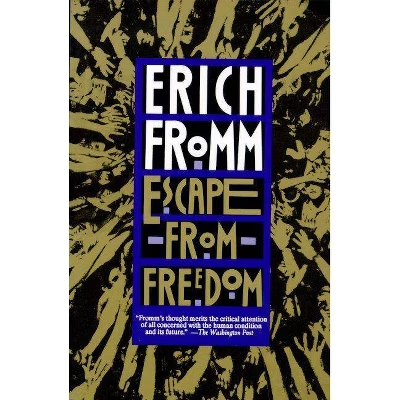
Fromm warned about our collective tendency to hand over our thinking to systems—to ideologies, to trends, to authority figures, to algorithms. And I see it in myself, too. I’m not immune to the pull of the crowd. I like being liked just as much as anyone else. I like the comfort of feeling “on track.” But I’ve also learned that there’s a deep cost to abandoning your own inner compass just to keep the peace or stay in step.
There’s a quote from The Art of Being that I’ve returned to many times:
“If other people do not understand our behavior—so what? Their request that we must only do what they understand is an attempt to dictate to us. If this is being ‘asocial’ or ‘irrational’ in their eyes, so be it. Mostly they resent our freedom and our courage to be ourselves. We owe nobody an explanation or an accounting, as long as our acts do not hurt or infringe on them.”
It’s not easy to live by that. But I’ve come to believe it’s necessary. Because the more we let other people’s comfort define our choices, the less alive we become. And the world doesn’t need more people going along just to get along. It needs people who are willing to risk being misunderstood in order to be more fully themselves.
Eric Hoffer echoed a similar truth in The True Believer, and I think about this often, too:
“Faith in a holy cause is to a considerable extent a substitute for the lost faith in ourselves. The less justified a man is in claiming excellence for his own self, the more ready he is to claim all excellence for his nation, his religion, his race or his holy cause.”


It’s easier to attach ourselves to group identities than to do the vulnerable work of cultivating a grounded, thoughtful, whole sense of self. But the Revolutionary Character doesn’t hide behind a movement or a slogan. They stand as themselves. Thoughtfully. Courageously. Imperfectly. And—most importantly—free.
That’s the kind of therapist I want to be. The kind of father I want to be. The kind of human I want to be. Someone who doesn’t just help people cope with dysfunction, but who creates space for people to imagine something better. Someone who’s willing to ask uncomfortable questions. Someone who sees through the noise and insists on something real.
I don’t get it right all the time. But I try to notice when I start slipping into autopilot—when I’m scrolling instead of connecting, reacting instead of reflecting, numbing instead of noticing. And when I catch it, I try to come back. Back to presence. Back to truth. Back to the slow, often unglamorous work of becoming.
Being a Revolutionary Character isn’t a title. It’s a posture. A daily decision. A quiet refusal to abandon yourself for the sake of fitting in.
And part of that decision, I think, involves asking the harder questions—not just about society, but about ourselves. About the parts of us that would rather follow than think. That would rather cling to a ready-made identity than risk the vulnerability of being real.

So here’s my invitation for you:
Start noticing the moments when the world asks you to trade authenticity for acceptance.
Start listening for the places inside you that already know what’s true—even if it’s inconvenient.
Start challenging the beliefs that keep you comfortable, yet disconnected.
Start paying attention to the tug in your gut when something feels off, even if everyone around you seems fine with it.
Start asking, Am I living my life, or just rehearsing the one I was told to want?
You don’t have to be loud. You don’t have to be certain. You don’t have to be fearless.
You just have to be honest. With yourself, first.
That’s the revolution.
Peace my Friends,
~Travis
PS. Feel free to share with me if anything here resonated with you.


